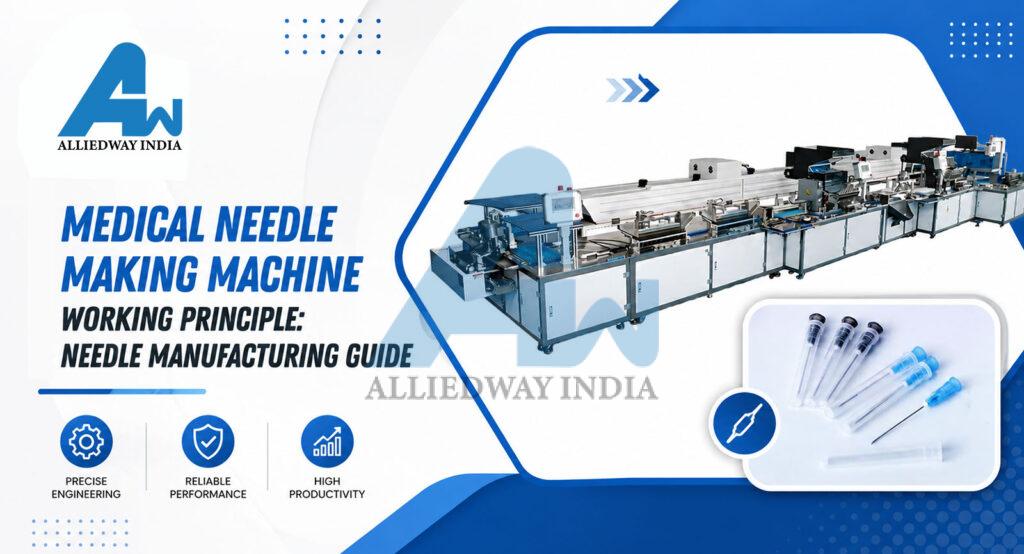

Overview – An IV Set Making Machine handles every stage of putting together an IV set, tube cutting, drip chamber assembly, needle insertion, air vent fitting, and leakage testing, all on one continuous line, which is what lets a manufacturer produce up to 4000 sets an hour with consistent quality. This blog explains how this machine actually works, what features matter for reliable output, and what to look for when choosing a manufacturer.
This blog covers:
Introduction
An IV set is a simple-looking product on the surface, with tubing, a drip chamber, a needle, and an air vent, but every one of these parts needs to be assembled precisely and tested for leaks, since the set is used to deliver fluids, medication, or blood directly into a patient. An IV Set Making Machine exists to handle this assembly consistently, at a scale that manual assembly simply cannot match, while keeping the same standard of quality on set number 4000 as on set number one.How an IV Set Making Machine Actually Works
A properly built IV Set Making Machine carries out several distinct stages on one continuous line, rather than needing separate machines or manual handoffs between steps. Tube cutting comes first, sizing the tubing to the exact length needed for the set. Drip chamber assembly follows, fitting the chamber that controls the flow rate visible to whoever is administering the fluid. Needle insertion and air vent assembly are fitted next, both needing precise placement since a poorly seated needle or a faulty vent can affect how the set actually performs once it is in use. Leakage testing happens at the end of the line, checking every completed set before it moves on to packaging, a set that leaks is a set that cannot be used safely on a patient.Features That Matter in a Reliable Machine
A few specific features separate a genuinely reliable IV Set Making Machine from one that will cause problems down the line. An easy-to-use control system means operators can run and monitor the machine without needing specialized technical training for every shift. Strong, durable parts matter for a machine expected to run continuously across long production shifts, since weak components wear out fast under that kind of repeated use. A compact design helps where floor space in a medical device manufacturing facility is limited, and low power consumption keeps running costs down over the machine’s working life. High-speed production capability, up to 4000 sets per hour on some machines, is what actually makes large-scale manufacturing practical rather than a bottleneck.Applications Across Healthcare Settings
An IV Set Making Machine produces sets used across a wide range of medical settings, not just general hospital wards.- Hospital supply manufacturing for general patient care
- Production of standard IV infusion sets
- IV sets specifically built for blood transfusion
- Disposable medical equipment manufacturing more broadly
- Bulk production runs for large-volume supply needs
- IV sets used in chemotherapy treatment
- Dialysis treatment sets with their own specific requirements
- ICU-specific IV sets, where reliability matters even more given the patients involved
Why Production Speed and Consistency Matter
Speed is of no use if the quality drops as the machine runs faster, so an IV Set Manufacturing Machine worth buying needs to deliver both together, not one at the expense of the other. A hospital or medical device company relying on a steady supply of IV sets cannot afford inconsistent quality between batches, since even a small defect rate becomes a real problem at the volumes involved in large-scale production. A well-built machine maintains the same tube cutting accuracy, the same chamber fit, and the same leak-free assembly whether it is running set number ten or set number four thousand in a shift. This consistency is really what separates dependable manufacturing equipment from a machine that only performs well when running slowly or under close supervision.Choosing the Right IV Set Making Machine Manufacturer
Picking a reliable IV Set Making Machine manufacturer comes down to a few practical questions worth asking before you commit to a purchase. Ask about actual production speed under real operating conditions, not just a theoretical maximum that assumes perfect, uninterrupted running. Ask what customization options are available, since not every buyer needs the exact same configuration, and a manufacturer offering only one fixed setup may not suit your specific product line. Ask about after-sale support and how quickly parts or service can be arranged if something goes wrong, since downtime on a production line making medical supplies has real consequences beyond just lost output. A manufacturer with years of experience specifically in medical device machinery, rather than general industrial equipment, generally understands these requirements more thoroughly.Talk to Alliedway India About Your Requirement
Alliedway India is a Faridabad, Haryana, based company that has been designing and manufacturing IV set making machine units since 2003 with more than 23 years of experience building customized medical device machinery. Our machines are capable of tube cutting, drip chamber assembly, needle insertion, air vent fitting, and leakage testing in a continuous line, with a production capacity of up to 4000 sets per hour.Frequently Asked Questions
What stages of IV set assembly does an IV set making machine actually handle?
A complete machine typically handles tube cutting, drip chamber assembly, needle insertion, air vent fitting, and leakage testing, all within one continuous production line, rather than requiring separate equipment or manual steps between stages.
How fast can an IV Set Making Machine produce sets?
This depends on the specific machine, but some models can produce up to 4000 sets per hour, which makes large-scale, consistent production practical for hospital supply and medical device manufacturing needs.
Can an IV Set Making Machine be customized for different types of IV sets?
Yes, machines can generally be customized for different applications, such as sets built specifically for blood transfusion, chemotherapy, or dialysis, which each have slightly different assembly requirements compared to a standard IV set.
Why does leakage testing matter so much in IV set manufacturing?
An IV set delivers fluids or medication directly into a patient, so any leak in the tubing or fittings can affect dosing accuracy or introduce contamination risk, which is why every completed set is tested before it moves on to packaging.